The Celtic Cross Tarot Spread, Explained Position by Position
The Celtic Cross is famous, flexible and easy to overcomplicate. Here is a straightforward way to lay it out, read each position, and turn ten cards into one coherent story.
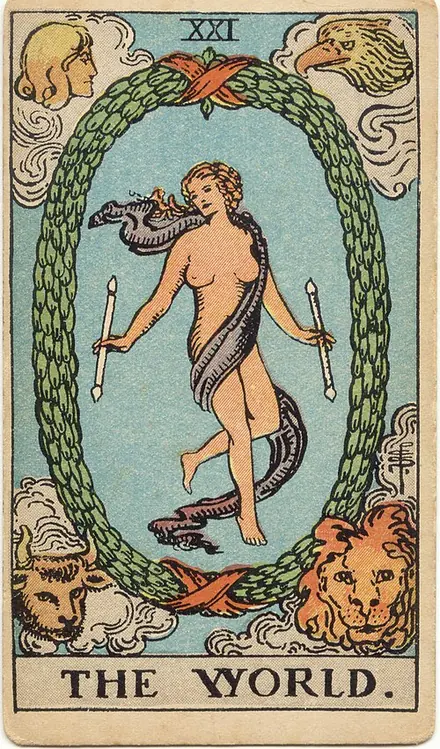
The Celtic Cross is the spread many people picture when they picture "a real tarot reading": ten cards, a small cross at the center, a column of four up the side, and the feeling that something official is happening. It has been popular in English-language tarot since the early twentieth century, when A. E. Waite published a version in his guide to the Rider–Waite–Smith deck. There is no single ancient, secret layout. There are several close cousins, and the one below is a clear, widely used modern form.
It is a good spread when a situation has a lot of moving parts — a relationship at a crossroads, a career decision with history and consequences, a repeating pattern you cannot quite name. It is a poor spread when you are asking a small question, or when you are already anxious and ten images will only give you more to worry about. In those cases, start with a three-card spread or our free reading tool. You can always come back to the Cross later, with a tighter question.
How to lay it out
Shuffle while you hold one clear question. Then deal the cards in this order, face up or face down and turned as you go — either is fine, as long as you are consistent.
The cross (cards 1–6):
- The present / the heart of the matter. Place this card in the center.
- The crossing card. Place it across the first card, usually sideways. This is the immediate challenge, the opposing force, or what is acting on the situation now.
- The foundation / the root. Below the center, at the base of the cross. The history or cause underneath the question.
- The recent past. To the left of the center (some readers put this on the right; pick a side and keep it). What is just leaving, but still coloring the present.
- The possible outcome, or the crown. Above the center. A potential you are heading toward, or the conscious goal — more "what is possible" than "what is guaranteed."
- The near future. To the right of the center (the opposite side from card 4). The next chapter, if nothing important changes.
The staff (cards 7–10), a column to the right of the cross, from bottom to top:
- You, in this situation — your attitude, role or position.
- The environment — other people, the setting, what surrounds the question.
- Hopes and fears — often both at once, which is why this position is famous for being tricky.
- The outcome — the most likely resolution of this path, not a fixed fate.
Leave enough table space that you can still see card 1 under the crossing card. If you read reversals, keep each card in the orientation it arrived in; see what reversed cards mean if you are still deciding whether to use them.
What each position is really asking
Positions 1 and 2 are the engine of the spread. Read them as a pair before you look at anything else. Card 1 is "what this is about." Card 2 is "what is across its path." A Two of Cups crossed by the Five of Swords is a bond under an unfair fight. The Magician crossed by the Seven of Cups is capability blurred by too many options. This is exactly the skill in our combination guide.
Card 3 keeps you from treating the present as if it came from nowhere. A foundation of The Devil or the Five of Pentacles tells you the current mess has a longer history — compulsion, scarcity, an old debt — than the last argument.
Card 4 is useful for perspective: it is already on the way out. Do not build a whole future on a card that belongs to the recent past. Card 6, the near future, is a trend. Card 5, above, is often a hope, a goal, or a possible flowering of the situation; compare it with card 10. If they agree, the path is relatively coherent. If they disagree, something in the middle (you, the environment, or a fear) is likely to change the trajectory.
Card 7 is not "your essence as a person." It is how you are showing up in this question. Card 8 is the weather around you: a workplace, a family, a partner's mood, a cultural pressure. The Hierophant or The Emperor here often points to institutions or other people's rules.
Card 9, hopes and fears, frequently holds a card you both want and dread: The Lovers can be the hope of a real choice and the fear of having to make it. The Tower can be the fear of collapse and, sometimes, a buried wish for the waiting to end. Read it psychologically, not as a secret extra outcome.
Card 10 is a likely landing place if you continue as you are. It is not a command. If you do not like it, look back at cards 2, 7 and 9 for the lever you can still move.
How to read it as a story, not ten separate fortunes
After you have named each position, go around the spread again and tell a story in this order:
- "At the heart of this is A, and what is challenging it is B."
- "That makes sense given the root C, and the fact that D is just leaving."
- "In the near term, E is coming into view; the potential, if things go well, looks like F."
- "I am in this as G, in an environment of H, hoping and fearing I."
- "So the path, as it stands, leads toward J — unless I change G or address B."
Then stop and ask whether that story matches the life you actually have. If it does not, you may have forced a memorized meaning. Look up the cards on their meaning pages and try the sentence again, more plainly.
A few patterns are worth watching across the whole Cross:
- Many Major Arcana — a chapter with real weight. Slow down; do not reduce it to one yes or no.
- A suit that dominates — many Cups, a feeling-led story; many Swords, a story of thought, conflict or communication; many Pentacles, practical stakes; many Wands, will and heat.
- A court card in 7 or 8 — a role you or someone else is playing. It may be a person, or it may be a style you have put on.
- Card 5 and card 10 in tension — the goal and the outcome do not match yet. The work is in the staff, especially cards 7 and 9.
A worked example
Suppose the question is: "What do I need to understand about staying in this job?"
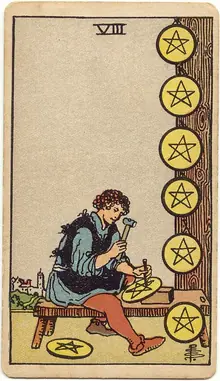
- Present: Eight of Pentacles — the work itself, skill, the daily craft.
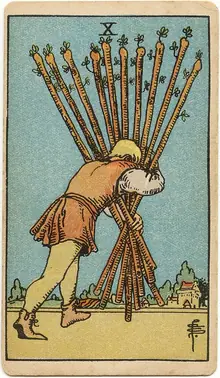
- Crossing: Ten of Wands — overload; the craft is being crushed by the load.
- Root: The Hierophant — a traditional path, a sense of duty, perhaps a career you were supposed to want.
- Recent past: Three of Cups — support, colleagues, a warmer chapter that is fading.
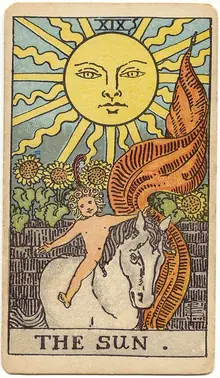
- Crown: The Sun — a real wish for simple joy and visibility in the work.
- Near future: Two of Swords — a stalemate if you do not choose.
- You: Nine of Wands — still standing, still guarded, tired of defending the role.
- Environment: King of Pentacles — a stable but demanding structure; a boss, an industry, a paycheck that is hard to argue with.
- Hopes and fears: Eight of Cups — the hope and the fear of walking away from something that once mattered.
- Outcome, if nothing changes: Four of Pentacles — you keep the security, and you hold on tighter.
The story is not "quit tomorrow" and it is not "stay forever." It is: you are good at the work, the load has become the problem, duty got you here, the friendly part of the job is fading, and if you do not make a choice you will freeze, then cling. The Sun in the crown says joy is a legitimate goal, not a luxury. A next step might be a conversation about the load, a boundary, or a serious look at leaving — which is a decision-making spread of its own, not a tenth extra card on this one.
Common mistakes (and when to skip the Cross)
Do not add clarifiers for every position. Ten cards already say plenty. Do not read card 10 in isolation and ignore the crossing card; the outcome is the child of the whole spread. Do not treat a difficult card 10 as a curse. Treat it as information about the current path.
If you are brand new, practice combinations and three-card stories first. A Celtic Cross will only be as clear as your ability to let two cards talk to each other. If you are asking a love question, consider a dedicated love spread before you put the entire relationship into ten positions.
And if you have already done a Cross on this question this week, do not do another. Write down the story, live with it, and act on the lever you can actually move. The Celtic Cross is at its best when you give it a real question and then give yourself time to hear the answer as one narrative — a cross at the center, a path up the side, and a life, still yours, waiting on the other side of the table.
Try it yourself: free three-card reading, card of the day, yes or no tarot, or the three-card spread guide.